
LeSS Newsletter October 2026
02-11-2026Hi 👋
This month the evidence all points one way. Two independent studies measured the same gap: engineers saving six hours a week while the share of time spent on new features did not move at all. Gartner predicted that 20% of organisations would use AI to cut more than half of their middle management positions by the end of 2026, how did that go?
The CafeTalk follows that thought: those managers also held the informal power, the ability to get a decision unstuck, so when the layer goes, who ends up holding it?
Bas Vodde names the everyday habits that quietly split a team into individuals working side by side, and the practices that pull it back together.
And an Austrian insurer moved to five feature teams and one Product Backlog, then listed what refused to follow: knowledge locked in individuals, and operations still outside the teams 🤔.
Every item this month says the same thing in a different voice: the gains can be real, and the organisation decides whether you ever see them.
This month’s ideas, ready to put into practice:
- 📊 Individual productivity goes up. Organisational productivity stays flat.
- 🗿 LeSS 2026 Tokyo Is a Wrap. Next Stop, Helsinki.
- 🤝 In-Team and Cross-Team Collaboration Practices by Bas Vodde
- 🎥 Ok, I Flipped to LeSS. Now What? with Adam Piekarczyk & Oskar Szewczyk
- 📰 The year the middle mngt was supposed to disappear
- ☕ CafeTalk 17: AI, Power & the Future of Management with Michael Mai
- 🏆 LeSS Case Study: Merkur Insurance by Wolfgang Richter
Enjoy, and keep learning!
Bastiaan van Hamersveld
CEO at less.works, email: bastiaan@less.works
Individual Productivity Goes Up. Organisational Productivity Stays Flat.
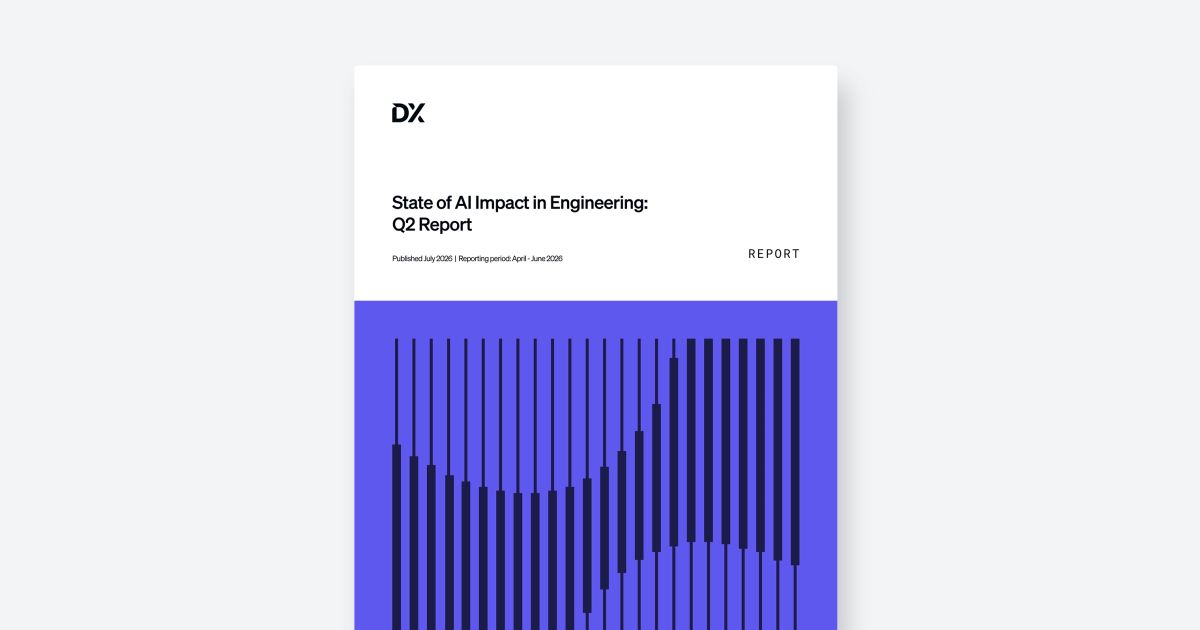
📊 Engineers are saving more than six hours a week. The innovation ratio has not moved at all.
DX measured 500+ organisations for its State of AI Impact in Engineering: Q2 Report. Utilisation is above 90% and throughput rose 37% in four quarters, from 1.42 to 1.94 pull requests per engineer per week. Meanwhile quarterly AI spend went from $1.5K to $44K, roughly 28x, and the innovation ratio stayed flat. Quality moved sideways too: maintainability improved while change confidence fell, failure rates now swing three points either side of a 4% benchmark, and pull requests nearly doubled in size 🤔.
“AI is making individual tasks faster, but the surrounding system is absorbing the slack rather than converting it into new value.”
Google’s DORA 2025 report reaches the same place independently: AI is an amplifier of an organisation’s existing strengths and weaknesses, and the returns come “not from the tools themselves, but from a strategic focus on the underlying organisational system”. Its sharpest finding: where the internal platform is weak, AI adoption does close to nothing for organisational performance. Where it is strong, the effect turns strongly positive.
What you’ll learn:
- Why over 6 hours saved per engineer per week is not showing up as new value at portfolio level
- How a 28x rise in AI spend sits next to a flat innovation ratio, and what leaders should pair every throughput metric with
- Why human review gates become the new bottleneck when individual output surges
- Why bigger AI budgets do not guarantee better returns, and smaller organisations get more output per dollar
- Why code got easier to read but harder to trust, and what that does to change failure rates
- From DORA: why platform quality decides whether AI adoption shows up in organisational performance at all
📊 Read the DX Q2 report → 🧭 Read the DORA 2025 report →
LeSS 2026 Tokyo Is a Wrap. Next Stop, Helsinki.

🗿 Announced here first: the 2027 conference is going to Helsinki.
On 8 and 9 October, BIPROGY in Toyosu hosted two days of practitioners from across Asia and beyond. The keynote that people kept talking about afterwards came from Kaname Hayashi, founder and CEO of GROOVE X, on Building the Organization Behind LOVOT, with a LOVOT robot on stage next to him.
He took the room through the GROOVE X LeSS journey: a company built deliberately without managers and without departments, growing to roughly 120 people while holding that shape. What made the talk valuable was that he did not sell it. He walked through the experiments, the ones that worked and the ones that did not, and he was specific about where LeSS fits their world and where it does not.
Hearing a CEO describe the boundary of a framework honestly is rarer than hearing one praise it.
Also, the photos from the conference will be published in the coming weeks 😉
The Global LeSS Conference 2027 will be held in Helsinki 🇫🇮
The Finnish organising team has started preparations and the venue will be announced soon, with dates to follow.
If you would like to speak, sponsor, or help organise, this is the moment to put your hand up, while the programme is still a blank page. Reach the organising team at conference@less.works.
In-Team and Cross-Team Collaboration Practices

🤝 Five habits that quietly turn a team into five individuals sitting together, and thirteen practices that pull them back into one team.
In this blog, Bas Vodde does something unusually practical: he names the actual practices. Not principles, not a maturity model, but the concrete things teams do every day, sorted into what to avoid and what to try.
The avoid list will feel familiar: each member has their own items, a sequential process with functional specialisation, everyone sticking to their single skill, feature hogging, and simply moving on to something else when blocked. None of it looks like a problem on a board. All of it raises work in progress and lowers the chance anyone learns anything from anyone.
Against that sit the collaborative practices, inside a team (design in Sprint Planning 2 with fine-grained tasks, multiple dailies, multiple pairs, mob programming, swarming) and across teams (no preselection, maximising dependencies rather than avoiding them, temp merge, multi-team Sprint Planning 2, travelling, leading team).
The closing point is the one to take to your management team: “Collaborative practices require a collaborative context to flourish.” That context has three dimensions, and all three are organisational decisions rather than team habits: modern engineering practices, feature teams with shared code ownership, and not playing the contract game of deadline pressure.
What you’ll learn:
- The five individualistic habits that look efficient and quietly raise WIP
- Six in-team practices worth trying, from multiple pairs to swarming and sacrificing a team member
- Seven cross-team practices, including why you would deliberately maximise dependencies
- Why collaboration dies without the surrounding context: engineering practices, team structure, and management behaviour
Ok, I Flipped to LeSS. Now What?
🎥 A regulated bank, years of organisational and technical debt, and one volunteer team allowed to work across the whole product. Then what happened at three, six and nine months.
At AgileByExample 2025, Adam Piekarczyk and Oskar Szewczyk walk through a LeSS adoption at a Polish software provider for the banking sector. They did not start with a reorganisation. They started with one self-designed, cross-functional team of motivated volunteers working across the entire product, and only after six months of good results did the company move to multiple cross-functional teams.
What makes this one worth the time is the honesty of the timeline. The talk reports back at three, six and nine months, including what still hurt.
What you’ll learn:
- How to introduce LeSS in a highly regulated banking environment carrying years of organisational and technical debt
- Why a pilot of volunteers beats an announced reorganisation, and what earns the mandate to expand
- Moving from departmental silos to cross-functional product teams, and what breaks on the way
- Getting to a single Product Backlog, and keeping development sustainable while the structure changes
- The three, six and nine month retrospectives: what held, what did not
The Year the middle mngr was supposed to disappear
📰 Gartner predicted that through 2026, 20% of organisations would use AI to flatten their structure, removing more than half of their middle management positions. We are in the last weeks of 2026. How did that go?
The flattening is real in places, and the reasoning is seductive: scheduling, reporting, status chasing and performance monitoring are exactly the kind of coordination work software can absorb. The same prediction warned about the other side of it, including managers left with far more direct reports than they can actually support.
Set that next to what the year measured. McKinsey’s State of AI 2026 survey found 80% of respondents saying AI improved their individual productivity, while only 37% could point to any contribution to EBIT, essentially unchanged from the year before. Cutting the layer that coordinates does not, by itself, produce value. It produces a gap, and somebody still has to do the coordinating.
Which is the quiet argument of this whole issue. Removing managers is not the same as removing the need for management, and the organisations that get something back are the ones that redesign where decisions and coordination actually live, rather than deleting a layer and hoping.
📰 Gartner’s prediction, in full →
CafeTalk 17: AI, Power & the Future of Management
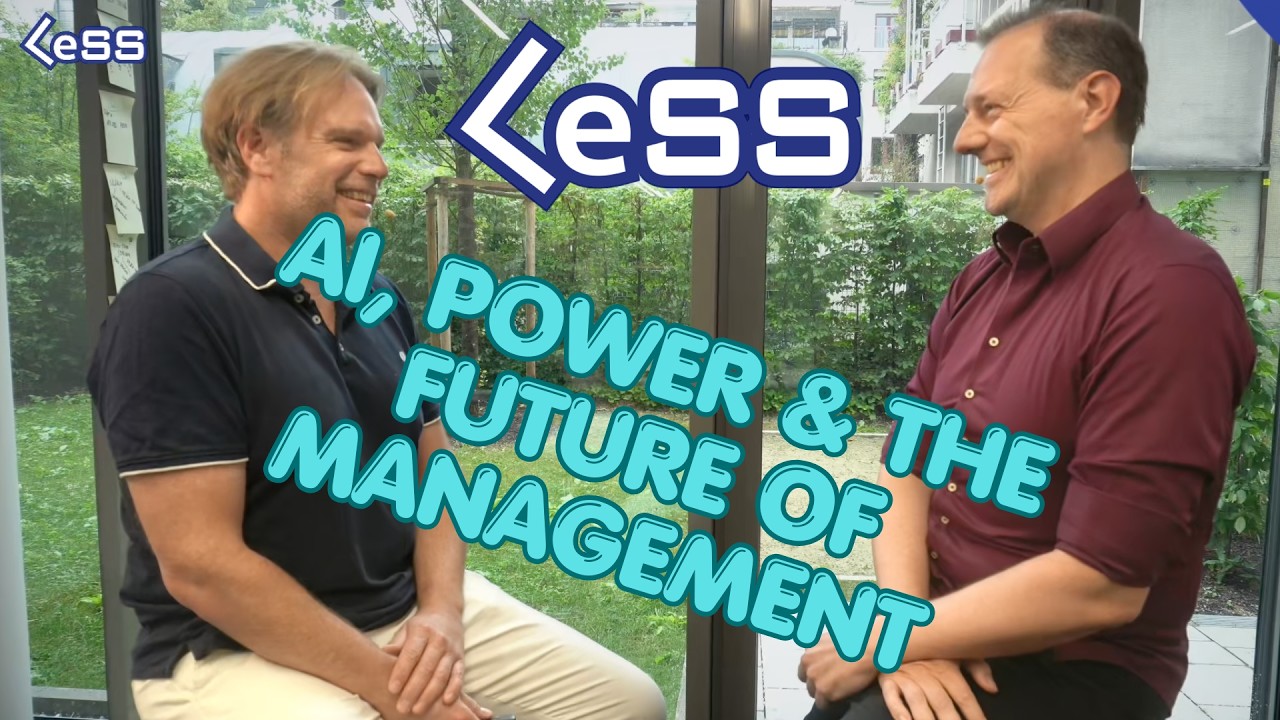
☕ Informal power sits where the uncertainty is. So where does it go when AI removes the uncertainty?
Bastiaan talks with Michael Mai, who coached the LeSS adoption in BMW’s autonomous driving organisation. His lesson from it: the adoption was planned 18 months ahead, reality disagreed within weeks. React to reality, not to the plan.
From there into power. Informal power tends to sit in the middle layer. Thin that layer with AI, and if the people creating value have no slack to think, you remove your capacity to innovate without ever deciding to.
What you’ll learn:
- Why informal power moves rather than disappears
- Why slack decides whether removing coordination creates capacity or destroys it
- Why a subscription without your own knowledge base returns recorded answers
- Where AI coordination helps, and where it should stay away
- How people will game an AI manager once the rules get complex
- The BMW managers who stepped down, kept their salary, and were happier for it
LeSS Case Study: Merkur Insurance

🏆 A legacy system that resisted replacement for eight years was rebuilt by one Scrum team in two. Then they scaled it, and found out which parts of the old organisation would not move.
Written by Wolfgang Richter, who coached the adoption alongside JIPP.IT, this case study follows Merkur Gesundheitsversicherung, one of Austria’s largest insurers, and specifically its roughly 50 person IT organisation: infrastructure, custom development, and a pile of heterogeneous legacy applications.
The route is told in four phases, from plan-driven failures through a single successful Scrum team to a full LeSS adoption with five cross-functional feature teams, one Product Owner replacing a distributed fake-PO situation, and a single Product Backlog in place of per-team lists. Component boundaries between Java and mainframe developers went away; line managers moved from assigning and controlling work to coaching and simplifying the organisation.
What makes it useful is that it is honest about what did not move. Knowledge silos built over decades did not dissolve on a Sprint boundary. IT Operations stayed outside the feature teams despite the intent to integrate. Group-level policies kept an escalation board and the project manager role in place. And two Scrum Masters for five teams is described plainly as too few.
What you’ll learn:
- How a two month preparation led to five teams starting Sprints concurrently, and what the first half year actually looked like
- Why the Sprint Planning 1 format they landed on was the first thing team members consistently said they were happy with
- What changes for line managers when assigning work stops being their job
- Where a corporate parent limits simplification, and which constraints you may simply have to carry
- The uncomfortable bits: knowledge silos, operations left outside, and Scrum Masters stretched too thin