_065_%20round%20copy.jpg) by Wolfgang Steffens
by Wolfgang Steffens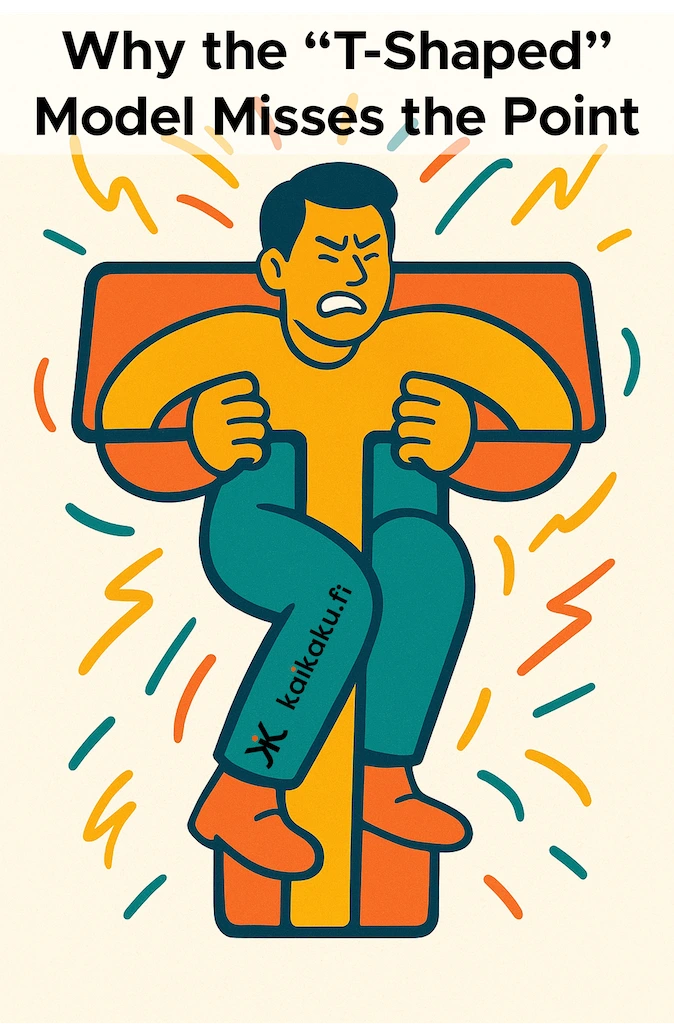
There’s a hidden assumption behind most organizational charts and role descriptions — one that shapes how work, teams, and even people are designed.
It’s the belief that knowledge is fixed, that what someone knows defines what they can contribute.
That’s why we hire specialists, build silos, and admire deep expertise. But we forget something fundamental: Learning is humanity’s greatest skill.
Humans are not static repositories of expertise — we’re adaptive learning systems. We learn through collaboration, experimentation, and purpose.
So why do so many organizations treat their people like components in a machine, squeezed into narrow specialist boxes or T-shaped clichés?
That’s the usual argument when I talk about building multi-skilled product developers.
And sure — I don’t want a heart surgeon operating on my brain either. But software development, product design, or even organizational improvement aren’t brain surgeries. They are collaborative problem-solving systems where value emerges from integrating perspectives — not from protecting silos.
The problem isn’t that people can’t learn; it’s that the system doesn’t allow them to. We create processes, KPIs, and career paths that reward staying in your lane instead of learning something new.
A multi-skilled product developer is not a generalist who dabbles in everything. They are someone who can:
They don’t replace specialists — they make collaboration work.
Multi-skilled developers increase adaptability, reduce dependencies, and create resilience in the product team. When work shifts, they shift with it. When problems cross boundaries, they follow the value, not the job description.
If learning is a human’s greatest skill, then organization design should amplify it, not restrict it.
Design structures where learning flows freely:
That’s how people — and organizations — become adaptive.
You don’t get resilience by hiring the best specialists. You get resilience by designing for learning.
So the next time you think,
“I don’t want my backend engineer touching the frontend,”
ask yourself instead:
“What system have I built that prevents learning, collaboration, and adaptability?”
Because the future doesn’t belong to the most efficient specialists — it belongs to the fastest learners.
Visit kaikaku.fi for more insights on organizational transformation and learning.

 RSS feed