 by Gene Gendel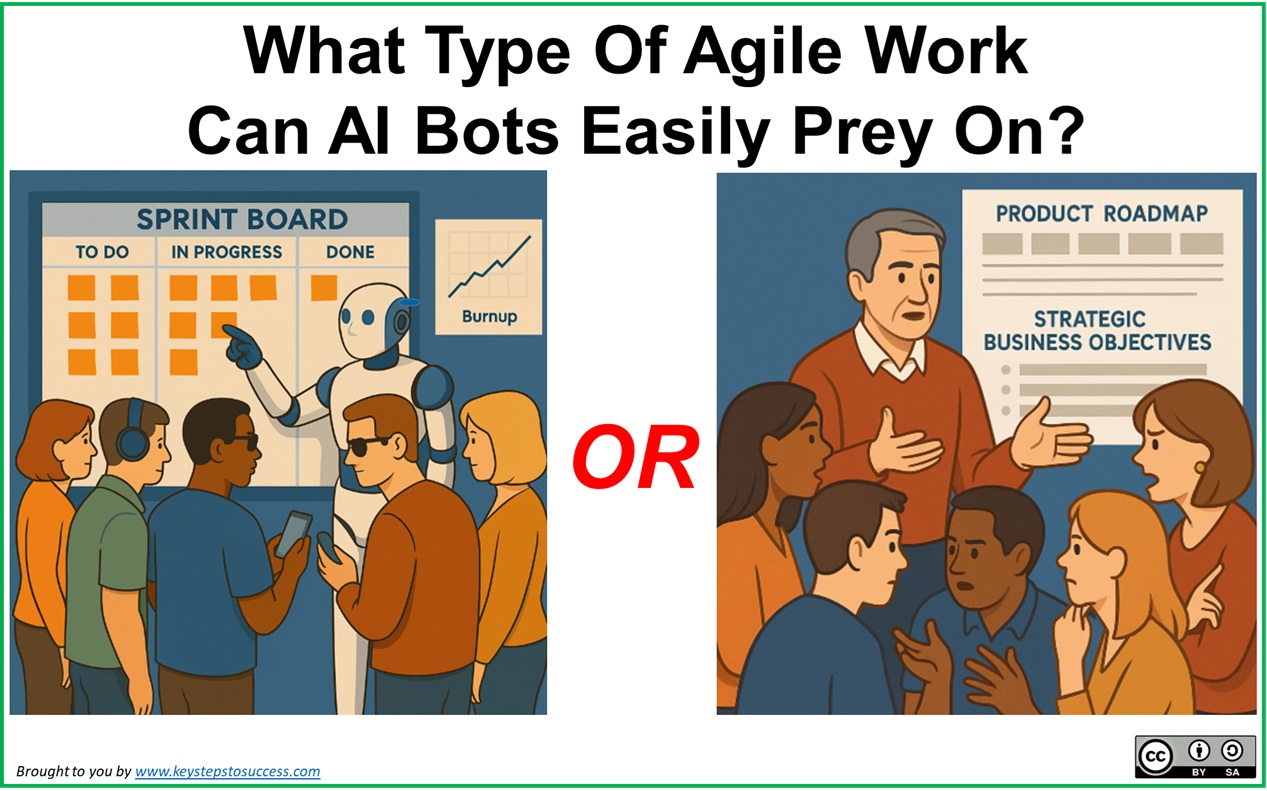
Artificial intelligence is reshaping nearly every corner of our lives, including the job market and the professions we’ve long considered uniquely human. Agile coaching and Scrum Mastering are no exception. Parts of these jobs, often the ones that were poorly or superficially defined in the first place, are far more vulnerable to automation than others.
Over the years, the true essence of these roles has often been diluted or misunderstood. Many organizations have redefined the Scrum Master and Agile Coach role until it looks superficial, administrative, or purely procedural. When a role is already stripped of its human complexity, replacing it with a bot becomes not only possible but obvious. Other responsibilities, the ones shaped by human behavior, organizational dynamics, and emotional intelligence, remain deeply and unmistakably human, because they rely on trust, presence, intuition, and the reading of relationships.
So what falls into each category?
Generating reports, dashboards, and executive status updates. Pulling burndown charts and “sprint summaries” out of Jira or Azure DevOps is rote, repetitive work. AI now does it instantly: pulling data directly from work systems, flagging anomalies, and writing a clean summary in seconds.
Creating basic training materials and explaining framework basics. “How Sprint Planning works” or “what is a Retrospective” decks are built from universal, heavily templated concepts, exactly where AI thrives. Ask it “what’s the purpose of a Sprint Review?” and it delivers a clear, consistent, textbook answer every time.
Facilitating simple events and monitoring the Sprint. AI standup bots already announce blockers and yesterday’s progress without missing a detail. In retrospectives, AI can ingest a transcript and instantly cluster themes (“delays were mentioned 14 times”), sorting and synthesizing without tiring or missing anything.
Identifying anti-patterns in empirical data. Scanning thousands of tickets for creeping cycle times or repeated bottlenecks is pure pattern recognition across large data sets, precisely the environment where AI excels and humans get exhausted.
Teaching mechanics: tooling and ADO/Jira navigation. Repetitive, procedural questions about tools and mechanics require no judgment or coaching skill: ideal territory for an always-available assistant.
Improving organizational structure, culture, and navigating politics. Culture doesn’t sprout from posters or keynotes. It emerges from structure, incentives, habits, and relationships built over years of small human interactions. No chatbot can read the political terrain of two directors jockeying for influence, or know when silence is more powerful than a suggestion.
Coaching leadership through mindset and behavioral change. Real coaching begins with honest, sometimes uncomfortable conversations: helping a leader recognize that their own behavior, not the team’s, is the actual impediment. That requires trust, empathy, and diplomacy that no algorithm has.
Coaching teams by building trust and improving team dynamics. Trust isn’t a dataset. It forms through shared experience: the moment someone finally opens up, the tension in a room that a skilled Scrum Master can sense before anyone says a word. Machines don’t register tone, energy, or the half-second of silence that signals discomfort.
Designing real product boundaries and teaching true product thinking. Meaningful product boundaries sit at the intersection of strategy, technology, customer value, and human dynamics. Moving an organization from project-thinking to real product ownership is a shift in worldview, not a process change, and only a human coach can walk a team through unlearning old habits.
Mediating conflict and ambiguous, emotional situations. When trust is fragile or two people have stopped speaking after a misunderstanding, no amount of historical pattern data helps. These moments call for presence, not more information.
AI is already absorbing much of the mechanical, repeatable, template-driven work in Agile coaching and Scrum Mastering, often more efficiently than humans ever could. The irony is that this work only became vulnerable because many of these roles were watered down or reduced to administrative functions in the first place.
That doesn’t mean every role deserves protection just because it carries a human title. If AI can perform a responsibility effectively, organizations shouldn’t cling to it for tradition’s sake. But they also shouldn’t worship AI as an all-purpose substitute. Not everything can, or should, be automated.
This moment calls for organizations to re-examine how they define these roles, separating the mechanical from the human, and the procedural from the meaningful. The responsibilities that rely on trust, emotional intelligence, courage, and systems thinking must stay in human hands, filled by people with the depth and authenticity to do the work well.
The emergence of AI is not a threat to Agile Coaching or Scrum Mastering. It is a clarifying force. It separates the title from the true craft. Organizations that embrace that distinction thoughtfully will use AI wisely, and will elevate the value of the human roles that remain.
Adapted from an original article by Gene Gendel, Certified LeSS Trainer and Agile Coach at KSTS Consulting.

 RSS feed