
LeSS Newsletter - July 2026
July 29, 2026Hi 👋
This month is about building the organisation you actually want, not chasing the next tool, but designing structures and growing the people who make great products and real change happen.
Tools don’t change organisations. People with the right structure around them do.
What’s inside this month?
- 🤝 Most AI Rollouts Fail on Change Management, via diginomica
- 🗾 Global LeSS Conference Japan 2026: first speakers announced, with Kaname Hayashi & Bas Vodde
- 🎥 How to Start a LeSS Adoption, with Viktor Grgic
- ☕ CafeTalk 14: LeSS as the Engine Driving Your POM, with Robert Briese
- 🛂 LeSS Case Study: SITA Border Security by Dinesh Sharma
- 🎓 Become a Certified LeSS Coach: the mentorship that changes how you lead change
Enjoy, and keep learning!
Bastiaan van Hamersveld
CEO at less.works, email: bastiaan@less.works
Most AI Rollouts Fail on Change Management, Not Technology

🤝 85% of knowledge workers use AI, yet only 29% have actually woven it into how they work. The gap isn’t the tooling.
Writing in diginomica, Alisa Yu makes the case that stalled AI rollouts are a change-management problem, not a technology one. The turning points weren’t new features: moving AI ownership out of IT and toward people-focused leadership, and pairing top-down direction with bottom-up experimentation, are what actually shifted behaviour.
What you’ll learn:
- Why relocating AI oversight from IT to people leadership drives adoption more than any feature
- How top-down safety and bottom-up experimentation have to run at the same time (top teams are 3.2× more likely to feel encouraged to experiment)
- Why culture and psychological safety have to precede the tools, not follow them
- Measuring behavioural change, speed, quality, use cases shared between colleagues, instead of login counts
A sharp outside-in confirmation of what we keep seeing: AI amplifies the organisation you already have.
Global LeSS Conference Japan 2026: First Speakers Announced!

🗾 The 2026 Global LeSS Conference Japan lands in Tokyo on October 8-9, and the first speakers are live.
We’re opening with two keynotes: Kaname Hayashi, creator of the family robot LOVOT (GROOVE X), and LeSS co-founder Bas Vodde. Check this video to see Mr. Hayashi and the actual working robots on stage. They’re joined by a growing roster, including Wolfgang Steffens, Alan Cyment, Robert Briese, Sofia Pelzl, Terry Yin and more, with the line-up still filling out.
🗾 See the speakers & register →
How to Start a LeSS Adoption

🎥 Where do you actually start a LeSS adoption, and why does the phase after the workshops so often stall?
In this conversation on the Get Agile podcast by ProCognita, Viktor Grgic walks through his approach to LeSS transformations: chasing root causes instead of symptoms, getting the real decision-makers engaged, and choosing the right group to start with. He uses feature-team adoption mapping and self-designing workshops to let the organisation shape its own structural change, because “owning the change by the group is critical to the success of the transformation.”
You will learn:
- How to pick a starting group and engage the decision-makers who can make change stick
- Why root-cause analysis beats treating the symptoms of a broken structure
- How feature-team adoption mapping and self-designing workshops define the new organisation
- Why the adoption phase after the workshops is the hard part, and how ownership carries it
CafeTalk 14: LeSS as the Engine, driving your POM
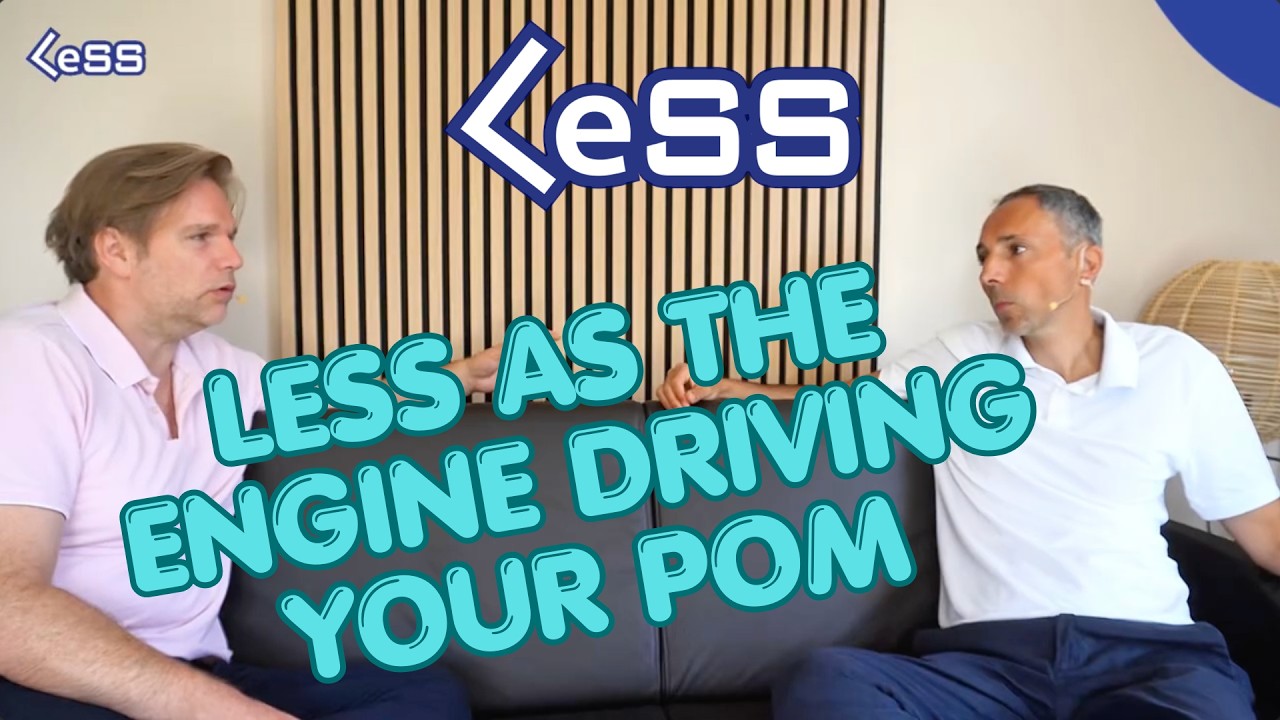
☕ The Product Operating Model and LeSS both refuse to be prescriptive, so where do they actually meet?
In this CafeTalk, Bastiaan sits down with Robert Briese to compare the Product Operating Model (POM) with LeSS. Both start from the same humbling premise, that we never really know what to build until we verify it, and both push teams to own the product, not just deliver it. Robert digs into where they reinforce each other and where POM’s single-role accountability quietly pulls against LeSS’s shared ownership of the whole product.
You will learn:
- Why both POM and LeSS treat “we don’t know what to build yet” as the starting point, not a failure
- How empowered teams own product outcomes rather than just delivering features
- The risk of single-role accountability, and why LeSS spreads responsibility across everyone
- Where LeSS enriches POM: events, artifacts, flatter hierarchy, and multi-team collaboration
- Why separating discovery from delivery so often goes wrong
LeSS Case Study: SITA Border Security

🛂 An 18-month, fixed-scope border-security contract, and a Director who refused to bet it all on a big-bang launch.
This LeSS case study follows Dinesh Sharma inside SITA’s build of a national border-security system: acquiring passenger data, screening every traveller against watchlists, all under real regulatory pressure and with an offshore team in Bengaluru. Starting from a hierarchical, siloed org, they moved from component teams to feature teams (with “Component Shepherds” as travelling mentors) and grew from 2 teams to 19 in 18 months without adding coordination roles.
What you’ll learn:
- How “Culture follows structure” (Larman’s Laws) shaped real cross-functional teams from day one
- The move from component teams to feature teams, and the Component Shepherd role that de-risked it
- How they scaled 2 → 19 teams in 18 months by descaling rather than adding roles
- Getting to continuous delivery under regulatory constraints, with feature toggles and staged deploys
The result: roughly 8× ROI, 5-6 new customers within two years, and an offshore team whose attrition fell to ~8% against a 20% market norm.
🍿 Read the case study → 🧑🎓 Explore more case studies →
Become the coach your organisation turns to when it has to change
🎓 An MBA doesn’t teach you business from a textbook, it puts you beside people who have run companies. The Certified LeSS Coach program does the same for the one skill that decides whether change actually sticks: leading it.
For a full year, you’re paired with a LeSS Mentor, a senior practitioner backed by The LeSS Company who has guided real adoptions through the exact resistance you’re facing. Not hypothetical case studies, but your live organisation: the conversation you need to have with your executive team, the restructuring you’re unsure about, the battle worth fighting this quarter and the one to let go.
What you get:
- 🧭 A year of 1-on-1 mentorship from someone who has done it, roughly a call or two every month
- 🏢 Coaching applied to your real organisation, not a workshop scenario
- 🗣️ The language to name what you see, so the case for change lands with the skeptical engineer, the turf-guarding manager, and the executive who’s heard it all
- 🎖️ The Certified LeSS Coach credential, though the certificate is the smallest part
Whether you’re a CTO leading the change, a manager building the capability in-house, or a coach ready to work at organisational scale, you come out able to do the work, not just describe it. For the cost of a few consultant days a year, you stop renting that capability and start owning it.
Ready to become the person your organisation turns to when it has to change, and stay changed?